Tuesday, April 10, 2012

Counting the holiday

Speaking of holiday, the Finnish way of calculating the annual holiday is really cryptic. The following example tries to explain how things go - but the system varies depending on whether you work for private company or state institution, and depending on the contract you're under.


First of all you have to earn your holiday before you can have them. In most of the cases you earn 2 holidays per month until you've worked in the same company and contract for one full "theoretic holiday year". After that you start earning 2,5 holidays per month. This theoretic holiday year is not a calendar year, but it lasts from April to March. So if you've started working in a company let's say from the beginning of November last year, you have earned 2*5=10 holidays, which you can keep during the summer holiday season (usually between May and September, in some places from June to September).

Let's clarify one term: by holiday we mean days when (according the law) you don't need to work, but you get full salary, and actually, you'll also get an extra bonus on top of the salary for each holiday - that's called holiday bonus.

Ok. Then comes the tricky part. If you have earned 10 holidays, it doesn't mean that you can be out of office for two full weeks - you need to count the Saturdays too, even though they are not normal working days. As an example, you could start your holiday on Monday. Until the end of the week you have spent 6 holidays (5 working days + extra Saturday), and you have 4 holidays left. So you should get back to office on the next week's Friday, that's when you've spent your 10 holidays. Luckily many employers may consider either giving some non-payed holidays, an option to balance with the flexible hours, or an option to swap your holiday bonus into holiday (i.e. then you don't take the bonus as money) - but this is something you definitely need to check from your employer, the practices vary a lot.

As said, this is a cryptic system and it varies depending on the contract, so you should definitely check and confirm your company's practices for example with your HR.

Monday, April 9, 2012

Egg jokes


    Advanced egg jokes: Pääsiäispatukka (Easter bar) and Isännän muna (egg that belongs to the man of the house).

There is one thing in the Finnish Easter traditions that you don't need to adopt: the egg jokes. Eggs have their place in the Easter traditions, but the whole thing boils down to the double meaning of Finnish word muna, egg: muna translates to egg, but it also refers to male equipment. And that's where the jokes emerge. One of the most common egg joke is to wish for munarikasta pääsiäistä, egg-rich Easter, especially for ladies. Or to warn "don't have too much egg, because it can make your belly to rise for several reasons".

I don't have anything against dirty jokes, in fact, I like dirty jokes. What bothers me with the egg jokes is the way people tell them. Egg jokes are usually told by people who are not exactly natural born comedians. They tell the egg jokes in such way as if they were the funniest jokes in the history of the humankind, and as if they were the first persons in the world who realized that egg has a double meaning in Finnish language. Of course those jokes are funny when you're teenager, but I'd expect a bit more from adults' jokes.

Sunday, April 8, 2012

As the saying goes: holiday

Next week is my winter holiday week. I'd appreciate if the weather didn't take it so literally. I'm not traveling anywhere,  so this is a staycation. To celebrate the staycation I thought I'd share some lazy and relaxed phrases:

Elä hättäile, istu mättäille. Don't hurry, sit on a hummock. Don't worry, sit on a hummock. 
Back to nature type of approach for reducing stress.


    This tree on my way to gym is growing partly on top of a stone. 
    To me it seems as if the tree had sat down on a stone to take a deep breath: elä hättäile, istu mättäille.

Vetää lonkkaa. To pull hip. 
This has nothing to do with pulling the leg, this is about being lazy and relaxed, to take a break.

Syljeskellä kattoon. To spit to the ceiling. 
When you really have nothing to do, you can just lay on the sofa and spit to the ceiling. But watch out, what goes up, comes down.

Levätä laakereillaan. To rest on one's bearings.
This phrase may often have a bit negative tone, it may refer to simple resting, but may also refer to wasting your potential.

Ottaa löysin rantein. To take with loose wrists.
If you take your life with loose wrists, you most likely have quite laid back attitude and you don't worry for too much.

Friday, April 6, 2012

Mary had a little lamb

Easter is fun, maybe the best church related holiday there is. Easter is laid back, it does not require as much effective performance as Christmas. Easter food is better than Christmas food. It's sunny. And office worker can always count on four days off - unlike on Christmas, which can be only three days in the shortest case.


And what do we eat on Easter?

Roasted lamb
Vegetables, roasted or fresh
Setsuuri, sweet and sour fennel-flavored bread
Eggs
Mämmi
Pasha
Chocolate eggs
Rahkapiirakka
And whatever tastes good


The best thing with Easter menu is the flexibility. On Christmas table you need to have the certain traditional dishes, prepared in certain way, according the one and only traditional family recipe. On Easter you can have a little bit of this and little bit of that, and you can be innovative and flexible with the actual execution: one year you may have lamb in coffee sauce, another year it's lamb in herb marinade.

One thing is for sure, on Easter you have to eat at home; practically no restaurants are open, at least not on Easter Monday. Only exceptions are Rosso and couple of other places.

Wednesday, April 4, 2012

Open on Easter?

Shop shop shop. Now. Because shops are closed on Friday, Sunday and Monday due to the Easter holidays. Which means that there's huge rush on Thursday and Saturday, be patient.

Small stores are allowed to be open on Monday for 4 hours between 8 AM and 6 PM. The K-market at Kamppi bus station is open also on Friday, Sunday and Monday from 10 AM to 10 PM. And if you run out of food, you can always order some kebab - that's made of lamb, and lamb is traditional Easter food.

    Most of the grocery stores are closed on Friday, Sunday and Monday. 
    You have to find your food somewhere else.


University's Pharmacy at Mannerheimintie 5, Helsinki city center is open every day from 7 AM to midnight. Movies are running quite normally on Friday, Sunday and Monday at Finnkino and at Kino Tapiola.

Tuesday, April 3, 2012

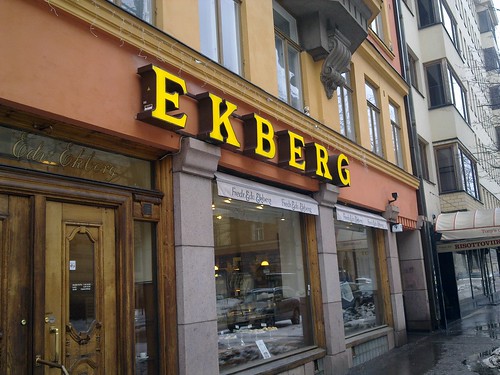
Ekberg

17.03.2012

Let's continue with the places where the local people go. Ekberg is a popular café in Helsinki city center, Bulevardi. Ekberg is a traditional and a bit old fashioned café with table service and French style pastries - maybe that's why mature ladies like the place. Ekberg's brunch is classic, they've been serving brunch long before brunching turned into a trend. Because of the brunch, on weekends the thirty-something generation shares the stage with the grannies.

Ekberg also has a take-away bakery shop right next to the café. So far it's the only place where you can get really good baguette in Helsinki. Also potato cakes (perunaleivos - yes, they look suspicious) and Napoleon cakes are delicious.

Monday, April 2, 2012

Eastern for Easter

Another traditional Easter desserts is pasha, sweet and creamy quark delicacy with lemon and raisins. Pasha as such is bit heavy to my taste, and therefore I prefer the pulla version of pasha. This is more or less traditional pastry from the Eastern Finland, Karelia.


First you need to make a pulla dough:

6 to 8 dl wheat flour
1 bag of dry yeast
2 tsp crushed cardamom
1 dl sugar
0,5 tsp salt
3 dl milk
1 egg
100 g butter

Mix 2 dl of flour with the dry ingredients. Add milk (40 C), egg and melted butter, and mix. Add the rest of the flour and mix. Knead for couple of minutes.


Let the dough rest under a cloth for at least 30 minutes, until it has expanded to double of its original size.


Mix the pasha filling while waiting for the dough to rise:

600 g quark
200 g sour cream
2 eggs
1 - 1,5 dl sugar
vanilla
peel of 1 lemon, grated
1,5 dl raisins


Spread the dough on the baking plate and pour the filling on top of it.


Keep it in 200 C oven for about 25 to 35 minutes.


Let it cool down properly before eating. That's the hardest part.